I'm a cognitive neuroscientist, which basically means I try to understand the neural basis of mental processes. More specifically, my research focuses on consciousness, self, empathy, social relationships, action perception and creativity. I use functional neuroimaging combined with behavioral studies of normal and clinical populations to examine the neural mechanisms that underlie our experience of resonating with other people and being aware of our selves.
Click the buttons below to read more about each topic.
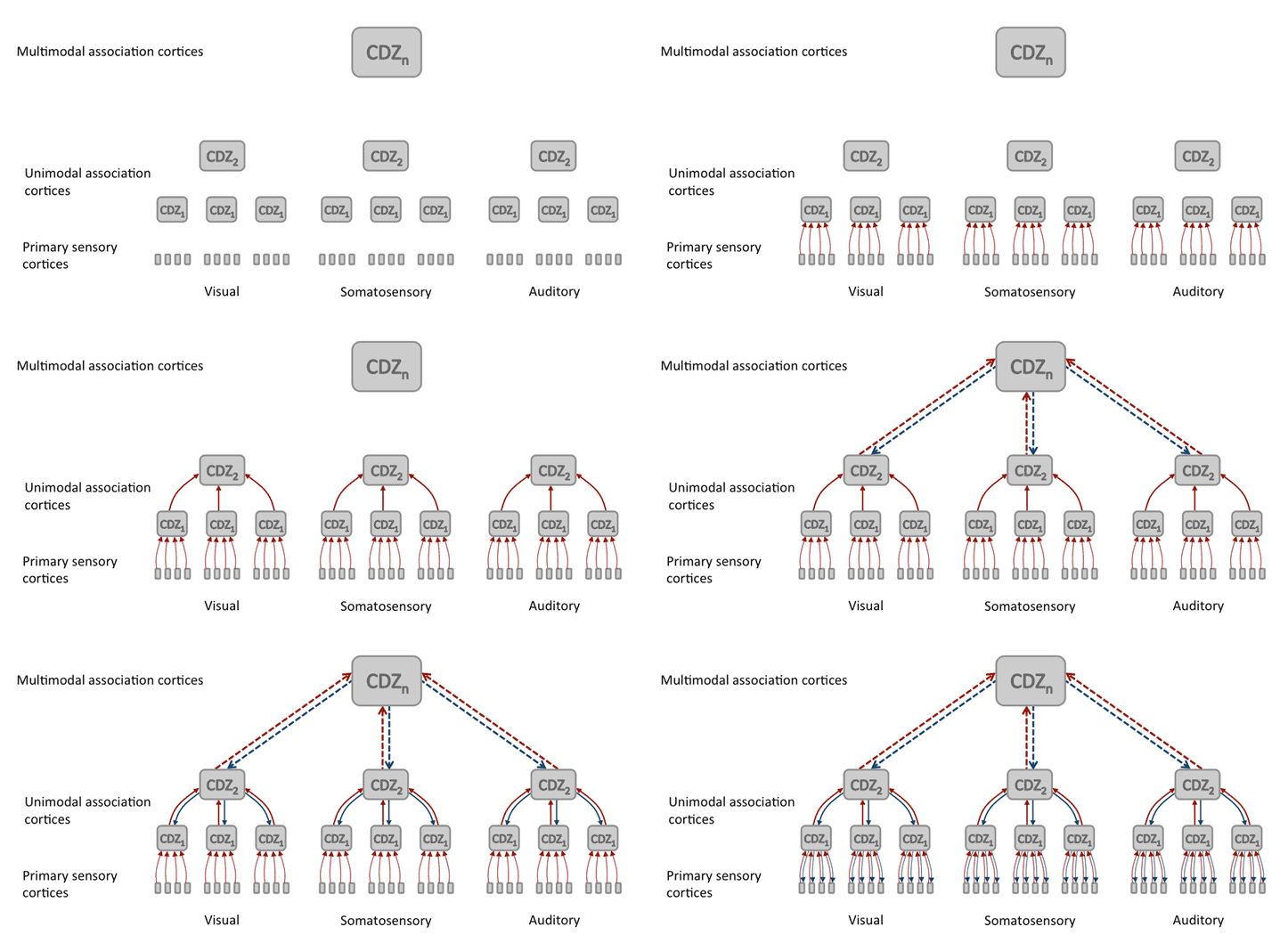
In the 1980's Antonio Damasio proposed a neural architecture in which neurons in high level association cortex serve as "converge-divergence zones", or CDZs. These neurons receive bottom-up inputs from multiple sensory modalities (convergence), and can therefore be activated by both the sight and sound of an object. However, they also send reciprocal projections back to lower level sensory cortices (divergence). Through these top-down connections CDZs are able to re-instantiate representations in early sensory cortices.
One prediction of this framework is that bottom-up activation triggered by a sensory stimulus in one modality will always be accompanied by associated top-down activation of other sensory modalities. For example, the sight of a bell would ultimately lead to activation of associated representations in auditory cortex as we hear the bell in our "mind's ear". Using multi-variate pattern analysis (MVPA), we found evidence that this is indeed the case (Meyer et al., 2010). In this first study, subjects watched a series of video clips that were silent, but implied sounds (e.g. a rooster crowing). Using voxels anatomically restricted to auditory cortex, we found that a support vector machine (SVM) could predict which video clip the subject was watching significantly better than chance. Thus the videos in our experiment evoked content-specific activation patterns in auditory cortex.
We next extended this finding into the somatosensory domain (Meyer et al., 2011). In that study subjects watched five videos that showed a hand touching one of several textured objects. Our SVM was able to predict which touch-implying video the subject saw using only voxels from somatosensory cortex. Furthermore, we found that these patterns in somatosensory cortex were similar enough across individuals that we could predict which stimulus someone was viewing using a classifier trained on data from different individuals (Kaplan et al., 2012).
Our current work seeks to extend these findings by directly examining interactions between stimuli presented through multiple sensory modalities.
Related publications:
| Man, K., Melo, G., Damasio, A., & Kaplan, J.T. (2020). Seeing objects helps us better hear the sounds they make. Neuroscience of Consciousness. | |
| Kaplan, J.T., Man, K., & Greening, S. (2015). Multi-Voxel Cross-Classification: Applying machine learning techniques to characterize abstraction in neural representations. Frontiers in Human Neuroscience. | |
| Man, K., Damasio, A., Meyer, K., & Kaplan J.T. (2015). Convergent and invariant object representations for sight, sound, and touch. Human Brain Mapping. | |
| Man, K., Kaplan, J., Damasio, H., & Damasio, A. (2013). Neural convergence and divergence in the mammalian cerebral cortex: from experimental neuroanatomy to functional neuroimaging. Journal of Comparative Neurology. | |
| Man, K., Kaplan, J.T., Damasio, A., & Meyer, K. (2012). Sight and sound converge to form modality-invariant representations in temporo-parietal cortex. Journal of Neuroscience, 32, 16629-16636. | |
| Kaplan, J.T., & Meyer, K. (2012). Multivariate pattern analysis reveals common neural patterns across individuals during touch observation. NeuroImage, 60, 204-212. | |
| Meyer, K. & Kaplan, J.T. (2011). Cross-modal multivariate pattern analysis. Journal of Visualized Experiments, 57, e3307. | |
| Meyer, K., Kaplan, J. T., Essex, R., Damasio, H., Damasio, A. (2011). Seeing touch is correlated with content-specific activity in primary somatosensory cortex. Cerebral Cortex, 21, 2113-2121. | |
| Meyer, K., Kaplan, J. T., Essex, R., Webber, C., Damasio, H., Damasio, A. (2010). Predicting visual stimuli based on activity in auditory cortices. Nature Neuroscience, 13. pp 667-8. |

This line of work focuses on understanding the neural systems involved in identity and self concept, including studies of how we recognize our own faces and voices, how we engage in the mental process of of self-reflection, and how we form a self-narrative or autobiographical self. I am also interested in how social group membership affects self-related neural processes.
Related publications:
| Araujo, H., Kaplan, J.T., Damasio, H., Damasio, A. (2015). Neural correlates of different self domains. Brain and Behavior. | |
| Araujo, H., Kaplan, J.T., & Damasio, A. (2013). Cortical midline structures in autobiographical self processes: an activation-likelihood estimation (ALE) meta-analysis. Frontiers in Human Neuroscience, 7: 584. | |
| Kaplan, J.T., Aziz-Zadeh, L., Uddin, L., & Iacoboni, M. (2008). The self across the senses: The neural response to one’s own face and voice. Social, Cognitive, and Affective Neuroscience, 3, 218-223. | |
| Kaplan, J.T., Freedman, J., & Iacoboni, M. (2007). Us vs. Them: Political attitudes and party affiliation influence neural response to faces of presidential candidates. Neuropsychologia, 45, 55-64. | |
| Uddin, L., Kaplan, J.T., Molnar-Szackas, I., Zaidel, E., & Iacoboni, M. (2005). Self-recognition activates the right hemisphere: an event-related fMRI study. NeuroImage 25, pp. 926-935 |
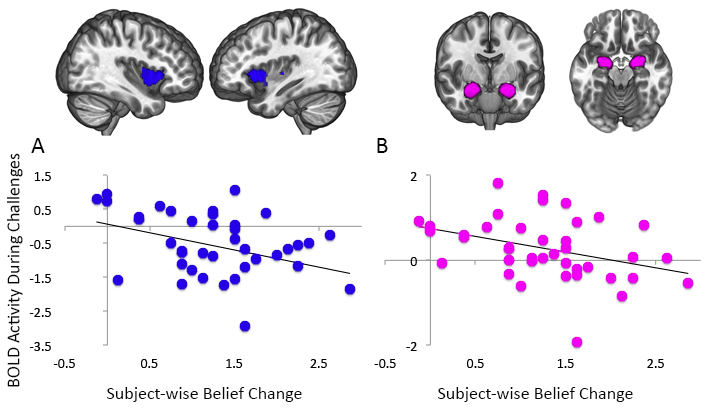
The goal of this project is to understand the neural mechanisms that underlie belief. We have found that specific brain systems are activated when people believe compared with when they disbelieve, and that these systems appear to be engaged similarly regardless of the content of those beliefs (religious or nonreligious). We have also explored the process of resistance to belief change for political beliefs.
Related publications:
| Kaplan, J.T., Vaccaro, A., Henning, M., & Christov-Moore, L. (2023). Moral reframing of messages about mask-wearing during the COVID-19 pandemic. Scientific Reports. | |
| Kaplan, J.T., Gimbel, S.I. & Harris, S. (2016). Neural correlates of maintaining one's political beliefs in the face of counterevidence. Scientific Reports. | |
| Harris, S., Kaplan, J.T., Curiel, A., Bookheimer, S., Iacoboni, M., & Cohen, M. (2009). The neural correlates of religious and nonreligious belief. PLoS One, 4(10). |
This work focuses on the neural basis of social cognition, including how we understand and empathize with others, and how our social relationships affect our brain functioning.
Graduate students:
Former collaborators:
Related publications:
| Christov-Moore, L., Reggente, N., Vaccaro, A., Schoeller, F., Pluimer, B., Douglas, P. K., Iacoboni, M., & Kaplan, J. T. (2023). Preventing antisocial robots: a pathway to artificial empathy. Science Robotics. | |
| Vaccaro, A., Heydari, P., Christov-Moore, C., Damasio, A., & Kaplan, J.T. (2022). Perspective-taking is associated with increased discriminability of affective states in the ventromedial prefrontal cortex. Social, Cognitive, and Affective Neuroscience. | |
| Sachs, M., Kaplan, J.T., & Habibi, A., (2019). Echoing the emotions of others: Empathy is related to how adults and children map emotion onto the body. Cognition and Emotion. | |
| Stoycos, S., Del Piero, L., Margolin, G., Kaplan, J.T., & Saxbe, D. (2017). Neural correlates of inhibitory spillover in adolescence: Associations with internalizing symptoms. Social Cognitive and Affective Neuroscience. | |
| Henning, M., Fox, G., Kaplan, J.T., Damasio, H., & Damasio, A. (2017). A Potential Role for mu-Opioids in Mediating the Positive Effects of Gratitude. Frontiers in Psychology. | |
| Fox, G., Kaplan, J.T., Damasio, H., & Damasio, A. (2015). Neural correlates of gratitude. Frontiers in Psychology. | |
| Saxbe, D.E., Del Piero, L.B., Immordino-Yang, M.H., Kaplan, J.T., & Margolin, G. (2015). Neural mediators of the intergenerational transmission of family aggression. Development and Psychopathology. | |
| Saxbe, D.E., Del Piero, L.B., Immordino-Yang, M.H., Kaplan, J.T., & Margolin, G. (2015). Neural correlates of adolescents' viewing of parents' and peers' emotions: Associations with risk-taking behavior and risky peer affiliations. Social Neuroscience. | |
| Habibi A, Ilari B, Crimi K, Metke M, Kaplan J, Joshi A, Leahy R, Shattuck D, Choi S, Ficek B, Haldar J, Damasio A and Damasio H. (2014). An Equal Start: Absence of Group Differences in Cognitive, Social and Neural Measures Prior to Music or Sports Training in Children. Frontiers in Human Neuroscience, 8:690. | |
| Sobhani, M., Fox, G.R., Kaplan, J.T., & Aziz-Zadeh, L. (2012). Interpersonal liking modulates motor-related brain regions. PLoS One 7(10): e46809. | |
| Mukamel, R., Ekstrom, A. D., Kaplan, J., Iacoboni, M. and Fried, I. (2010). Single neuron responses in humans during execution and observation of actions. Current Biology, 20. pp 750-756. | |
| Greene, D.J., Mooshagian, E., Kaplan, J.T., Zaidel, E., & Iacoboni, M. (2009). The neural correlates of social attention: Automatic orienting to social and nonsocial cues. Psychological Research, 73, 4, 499-511. | |
| Kaplan, J.T. & Iacoboni, M. (2007). Multisensory action perception in left ventral premotor cortex. Cognitive Processing, 8. 103-113. | |
| Kaplan, J.T., Freedman, J., & Iacoboni, M. (2007). Us vs. Them: Political attitudes and party affiliation influence neural response to faces of presidential candidates. Neuropsychologia, 45, 55-64. | |
| Kaplan, J.T., & Iacoboni, M. (2006). Getting a grip on other minds: Mirror neurons, intention understanding, and cognitive empathy. Social Neuroscience, 1, 175-183. | |
| Molnar-Szakacs, I., Kaplan, J.T., Greenfield, P.M., & Iacoboni, M. (2006) Observing action sequences: The role of the fronto-parietal mirror neuron system. NeuroImage, 25, 926-35. | |
| Kaplan, J.T. & Iacoboni, M. (2005). Listen to my actions! Behavioral and Brain Sciences. |
Morteza Dehghani
Kenji Sagae
Sarah Gimbel
Mary Helen Immordino-Yang
Antonio Damasio
Hanna Damasio
Related publications:
| Vaccaro, A.G., Scott, B., Gimbel, S.I., & Kaplan, J.T. (2021). Functional brain connectivity during narrative processing relates to transportation and story influence. Frontiers in Human Neuroscience. | |
| Dehghani, M., Boghrati, R., Man, K., Hoover, J., Gimbel, S.I., Vaswani, A., Zevin, J., Immordino-Yang, M-H., Gordon, A., Damasio, A., & Kaplan, J.T. (2017). Decoding the Neural Representation of Story Meanings across Languages Human Brain Mapping. | |
| Kaplan, J.T., Gimbel, S., Dehghani, M., Immordino-Yang, M-H., Sagae., K., Wong, J., Tipper, C., Damasio, H., Gordon, A ., & Damasio, A. (2016). Processing narratives concerning protected values: A cross-cultural investigation of neural correlates. Cerebral Cortex. | |
| K. Sagae, A. S. Gordon, M. Dehghani, M. Metke, J. S. Kim, S. I. Gimbel, C. Tipper, J. Kaplan and M.H. Immordino-Yang. (2013). A data-driven approach for classification of subjectivity in personal narratives. In Proceedings of the 2013 Workshop on Computational Models of Narrative, OASIcs XX, Scholss Dagstuhl. |
Morteza Dehghani and I have started the Brain Imaging and Machine Learning journal club at USC to bring together people on campus interested in these topics. If you're interested in joining us, you can visit the wiki or to be added to the mailing list.
Related publications:
| Kaplan, J.T., Man, K., & Greening, S. (2015). Multi-Voxel Cross-Classification: Applying machine learning techniques to characterize abstraction in neural representations. Frontiers in Human Neuroscience. |